Protect students, meet safety requirements, and keep your program in compliance with welding school fume extraction systems sized for the classroom.
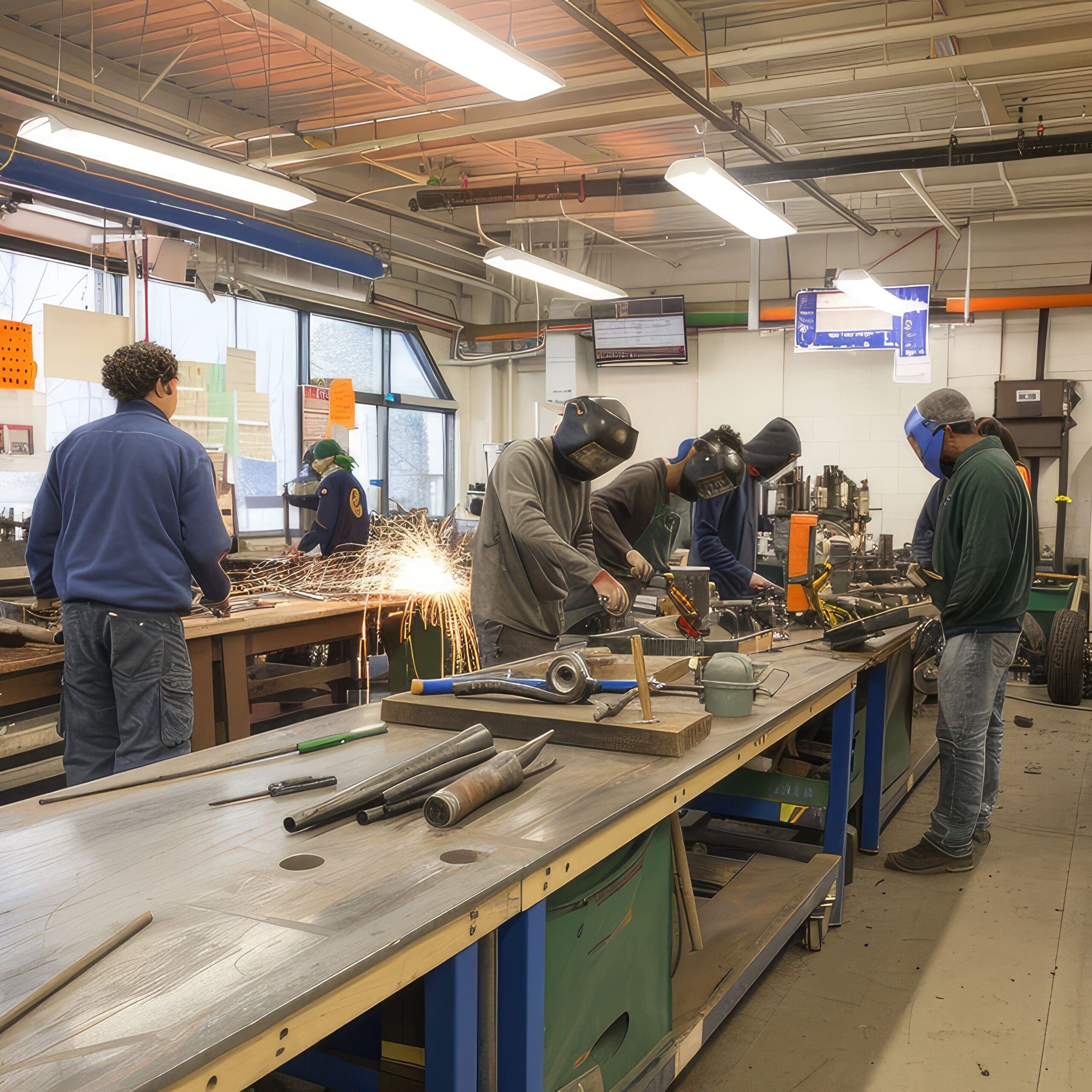
A single welder in an industrial shop produces a manageable, predictable fume load. A classroom with 15 to 30 students striking arcs at the same time is an entirely different situation.
Beginners spend more time at the arc. Technique is inconsistent. Heat input varies. The result is sudden, dramatic spikes in airborne particulate, hexavalent chromium, manganese, and zinc fumes that a standard HVAC system cannot handle.
Welding school fume extraction has to be designed for this environment, not adapted from a single-station industrial setup. That is exactly what we do.
When it comes to controlling fumes in a multi-student welding environment, source capture is the standard.
Source capture removes fumes at the point of generation, before they enter a student’s breathing zone. Common methods include extraction arms, backdraft tables, and downdraft tables positioned at individual stations. This approach aligns with OSHA requirements and ACGIH recommendations, making it the preferred control for multi-station welding school fume extraction.
Ambient filtration uses overhead or ceiling-mounted units to filter fumes after they have dispersed into the room. It serves as a reliable secondary layer for multi-station environments where complete source capture is difficult to achieve. For welding school fume extraction, it works best as a backup alongside source capture, not on its own.
Welding fumes are a documented health hazard, and OSHA’s Permissible Exposure Limits apply to educational environments the same way they apply to industrial facilities.
Key exposure limits to know:
The American Welding Society’s F3.2 standard establishes ventilation requirements for welding environments, including guidance on source capture and general exhaust.
Programs that do not meet these standards face audits, liability exposure, and real risk to student health. Properly sized welding school fume extraction systems are your first line of defense.
Environmental Air Technology helps you understand what your program requires and identify equipment that meets or exceeds those standards.
There is no one-size-fits-all configuration for educational programs. We help you select the right system based on your station count, room layout, welding processes, and budget.
One large collector is ducted to 10-40 individual student booths. This is the right approach for permanent, high-volume programs that need welding school fume extractor collection to scale reliably across an entire facility.
Individual, wall-mounted units with flexible extraction arms give each station dedicated capture without taking up floor space. A strong option when the booth layout is fixed and a full duct network is impractical.
Portable units work well for programs with flexible layouts, multi-process classrooms, or smaller facilities. No installation required and easy to reposition as your program grows or changes.
Not sure which configuration fits your space? We size the system to your actual station count and welding processes, not a generic spec sheet.
Environmental Air Technology serves trade schools, vocational programs, community colleges, and university welding programs across our service areas. Whether you are outfitting a new facility or upgrading an existing classroom, we are ready to help you find the right solution for your space.
Environmental Air Technology has helped educational programs select welding school fume-extraction systems that meet daily classroom demands and safety requirements. We get the solution right the first time, so your program doesn’t have to revisit it next semester.
Protecting students starts with having the right information. These are the most common questions we receive about welding school fume extraction, ventilation requirements, and system maintenance.
The best welding school fume extraction system depends on your station count, room layout, and welding processes. Most multi-station programs benefit from source capture at each booth combined with an ambient filtration layer overhead. Centralized systems suit large permanent labs, while wall-mounted or portable units work well for smaller or flexible programs. We help you identify the right configuration for your space.
A common starting point is 1,000 to 1,500 CFM per station for source capture, but the actual requirement depends on your hood design, duct losses, booth enclosure, and welding process. MIG and flux-core welding generate more fumes than TIG welding. We calculate the total system airflow based on your station count and process mix to ensure nothing is undersized.
Filter life depends on how many students are welding, the frequency of lab use, and the materials being welded. High-use classrooms with 20 or more active stations may need filter inspection every few months. Many systems include differential pressure gauges that indicate when a change is needed, so maintenance stays on schedule without guesswork.
OSHA requires that exposures stay below established PELs, but does not mandate a specific capture method by name. In a multi-student classroom, general ventilation alone is rarely sufficient to meet those limits. Source capture is the control method most likely to achieve compliance and aligns with both ACGIH guidance and AWS F3.2. It is the standard approach for programs that want to protect students and reduce liability.