
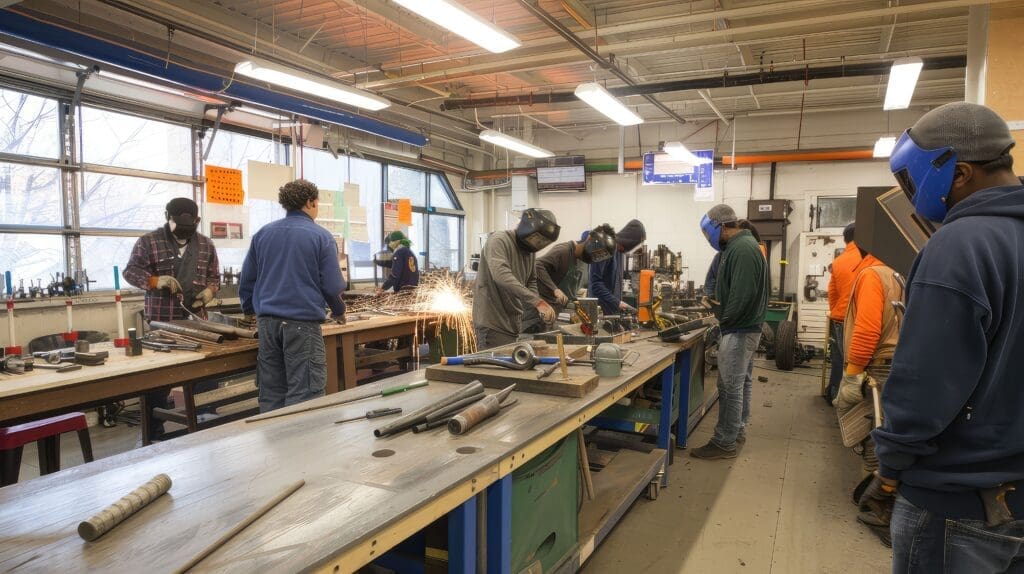
Welding school fume extraction is the difference between a lab where students want to show up and one where complaints, coughing, and calls to the front office pile up week after week. When a dozen or more students are striking arcs at the same time, in the same room, fume builds faster than most facilities ever plan for. Choosing the right welding school fume extraction system protects your students, your instructors, and your program’s reputation with parents, administrators, and accreditors alike.
A single production weld cell has one welder generating fume on a predictable schedule. A multi-station training lab has ten, twenty, or more students welding at once, often with inconsistent technique and constantly shifting body position. That means welding school fume extraction systems have to handle overlapping fume plumes from every direction, not just one steady source.
Add in rotating class periods, different welding processes throughout the day, and instructors who spend hours standing near active booths, and it becomes clear why choosing the right welding school fume extraction system starts with understanding real classroom behavior, not just square footage.
Before comparing any welding school fume extraction system, count your peak simultaneous stations, not your total booth count. A room with fifteen booths but only six running at once during a typical class period has very different airflow needs than a lab where all fifteen fire up together for a group project.
This number drives almost every other decision, from blower sizing to duct diameter to how many fume arms you need per row. Get this number wrong, and even a well-built welding school fume extraction system will fall behind the moment a full class gets to work.
Room size and ceiling height change how fume behaves once it leaves the arc. In a large open shop with high ceilings, fume has more room to disperse before it reaches a breathing zone, but it also travels farther before extraction ever pulls it in.
In a smaller, more enclosed lab, fume concentrations build up fast, and dilution ventilation alone rarely keeps pace. This is exactly why source capture matters so much when choosing the right welding school fume extraction system. Instead of trying to clean the whole room’s air after the fact, the goal is to pull fume as close to the arc as possible, before it ever gets a chance to spread toward a student’s face.
Layout matters as much as square footage. Booths lined up against a wall support a different duct and arm configuration than stations spread across an open floor. Your welding area’s actual footprint should shape your system, not the other way around.
This is one of the most common questions instructors and facility managers ask when choosing the right welding school fume extraction system, and the answer depends entirely on your building.
Ducted systems route captured fume outside through fixed ductwork. They tend to work well in facilities with the structural flexibility to run ducting and where continuous, high-volume extraction across many stations is the priority.
Ductless systems filter and recirculate air back into the room through self-contained units. They are often a strong fit for facilities with limited structural options, rented spaces, or programs that need the flexibility to reconfigure a lab as enrollment or curriculum shifts.
Neither option wins in every situation. Many welding schools opt for a hybrid setup, with a ducted backbone in fixed booths and ductless units covering flexible or overflow areas.
Placement is where many training labs lose effectiveness, even with a properly sized welding school fume-extraction system. Fume arms and hoods need to sit close enough to the arc to capture fume at the source, but they also need to move out of the way during instruction, tool changes, and student movement around the booth.
A fume arm positioned too far from the weld pulls in far less contaminated air than one placed correctly, even when the extraction unit itself is powerful enough to do the job. Instructors should be able to reposition arms quickly between students without slowing down a class period.
For fixed weld booths, ceiling-mounted or wall-mounted arms with a wide range of motion tend to hold up best under constant repositioning. For open-bay layouts, portable units paired with properly placed hoods give programs the flexibility to adapt as class sizes and projects change throughout the year.
Training labs put filtration systems through more wear than most industrial settings ever see. New students learning proper technique often produce more fume and spatter than experienced welders, and equipment gets bumped, moved, and readjusted constantly between class periods.
Filters should be checked on a defined schedule, not just when airflow noticeably drops. Different processes across different classes, along with aluminum welding or heavier spatter, can also affect filter life and cleaning frequency. Ask any provider directly what routine maintenance looks like, how often filters need replacement in a high-use lab, and what a realistic long-term cost of ownership looks like once filters, ducting inspections, and arm servicing are factored in.
Choosing the right welding school fume extraction system means choosing one that is easy for staff to maintain between classes. A more powerful system that gets neglected because upkeep is too complicated will underperform a simpler one that actually gets serviced on schedule.
Every welding school faces its own combination of room size, station count, layout, and turnover, and no single system fits every program. What matters most is working through these variables with someone who has solved this exact problem before.
Environmental Air Technology has spent decades helping facilities size and configure air quality solutions that match how a space is actually used, not just how it looks on paper. Contact us today to work with a team that can help you get it right the first time.