
Step inside a busy warehouse or factory and you will feel it immediately. Forklifts move in and out of open doors. Production equipment runs nonstop. Dust, debris, and outside air constantly try to invade the space. Over time, air quality deteriorates. Employees breathe in airborne particles. Clean storage areas no longer stay as clean as they should.
For warehouses, factories, loading docks, and food processing plants, air quality is not a luxury. It directly impacts productivity, comfort, and operational efficiency. That is why down draft tables play such an important role in industrial air management. When combined with strategic airflow solutions like air curtains, they create a powerful system that keeps contaminants under control and environments stable.
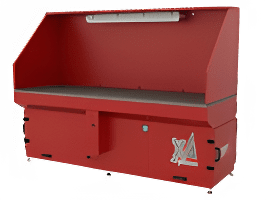
Down draft tables are specialized workstations designed to capture dust, fumes, and airborne particles at the source. Instead of allowing contaminants to rise into the breathing zone and circulate throughout the building, these tables pull air downward through a filtration system.
In a manufacturing setting, tasks such as sanding, cutting, grinding, or packaging can release fine particles into the air. Without control, those particles drift into surrounding work areas and even into storage spaces. Down draft tables immediately draw contaminants down and away from employees.
This source-capture approach prevents widespread air contamination and supports a cleaner, safer workspace.
One of the most effective ways to improve indoor air quality is to prevent pollutants from entering. Down draft tables do exactly that.
By pulling airborne debris downward, they help:
In large warehouses and factories, even small amounts of dust can quickly spread through open spaces. Down draft tables prevent this chain reaction by containing particles right where they are created.
The result is better air control without disrupting workflow.
In many facilities, certain zones naturally produce more dust than others. For example, a manufacturing room may generate particles that should never reach a nearby storage area. Installing physical doors or partitions can interrupt efficiency and restrict movement.
This is where air curtains complement down draft tables.
An air curtain creates an invisible wall of high-velocity air across an opening. Instead of installing a solid barrier, facilities can use an air wall to separate dirty and clean spaces. Dust from a production area is stopped midair before it drifts into storage.
There are no doors slowing down forklifts or employees. There are no structural changes required. Just a steady stream of air maintaining separation.
When down draft tables capture contaminants at the source and air curtains prevent migration between zones, facilities achieve layered air control that works with operations instead of against them.
In warehouses and loading docks, overhead doors open constantly. Forklifts move in and out throughout the day. Every time a door opens, conditioned air escapes, and outside air rushes in.
During winter, heated air pours out. In summer, cool air disappears. Energy costs rise. Employees feel drafts. Dust and debris enter from outside.
This is where air curtains truly shine.
Installed above high-traffic doors, air curtains create a powerful stream of air that acts as a barrier while allowing forklifts to pass freely. They help:
When paired with down draft tables inside the facility, this solution addresses both internal and external air quality challenges. The doors stay open for efficiency, yet airflow remains controlled.
For warehouses and factories, this combination protects comfort and reduces energy loss without slowing operations.
Air quality management is not limited to dust and temperature control. Insects are a real concern for loading docks and food processing plants, especially those near agricultural areas.
High-velocity air curtains provide a practical solution for insect control. The force of the air stream prevents flying insects from entering through open doors. In tougher environments, powerful airflow can even knock grasshoppers off train cars or trucks before they enter the building.
Rather than relying solely on screens or chemical treatments, facilities can use air movement itself as a protective barrier. This proactive approach keeps pests outside where they belong while maintaining full accessibility for deliveries.
Combined with down draft tables that manage indoor airborne particles, air curtains strengthen overall air quality protection.
Improving air quality in a warehouse or factory requires more than a single solution. Down-draft tables focus on source capture, removing contaminants as they are generated. Air curtains manage airflow at doorways and between work zones, preventing outside intrusion and cross-contamination.
Together, these systems:
For facilities that depend on consistent performance, cleaner air reduces disruptions and creates a more controlled working environment.
Air quality problems rarely stay small. Dust spreads. Conditioned air escapes. Insects find their way inside. Over time, these challenges impact productivity and costs.
Down draft tables and air curtains offer a proven way to control airflow in warehouses, factories, loading docks, and food processing plants.
To explore the right solution for your facility, whether you’re working with combustible dust or need better air quality solutions, contact our team at Environmental Air Technologies at 800-873-3458. A tailored approach can help you create cleaner air, better climate control, and a more efficient industrial environment from the ground up.